Reframing Globalization
In Underground Empire, Farrell (Johns Hopkins University) and Newman (Georgetown University) challenge the traditional view of globalization as a decentralized, market-driven phenomenon, arguing instead that it is deeply rooted in political power and shaped by strategic control over key infrastructures.
The book’s central thesis is the U.S. position of control over critical infrastructures—such international payment and financial messaging systems, internet architecture, and, more recently, cloud computing—has given rise to what the authors define as an “underground empire.” This empire is not visible in the traditional sense. It rests on the existence of chokepoints—technological and institutional nodes that are essential to the functioning of the global economy. Control over these chokepoints enables a disproportionate influence over global flows of money, data, and goods.
The Post-9/11 Shift
The transformation of economic infrastructure into instruments of statecraft began in earnest after the September 11 attacks. U.S. agencies like the National Security Agency and the Treasury Department began mapping global networks to identify vulnerabilities for the U.S. and opportunities for increased surveillance and control. Initially, these efforts were reactive — focused on tracking terrorist financing and enforcing sanctions against rogue states like Iran and North Korea.
However, the U.S. gradually realized that it could use its privileged position within global networks to shape the behaviour of other states and non-state actors. By leveraging access to financial systems, data centers, and undersea cables, the U.S. could impose costs on adversaries without direct military engagement. What began as a crisis-driven response evolved into a broader strategic doctrine.
Farrell and Newman believe that the weaponization of economic infrastructure did not stem from a fully conscious grand strategy. Rather, it emerged through a series of ad hoc decisions made in response to specific threats.
The Global Economy as a Geopolitical Arena
Firms that once operated under the assumption of political neutrality of the global economy find themselves increasingly entangled—willingly or not—in geopolitical rivalries.
Key manufacturers like TSMC and Apple are increasingly being called upon by governments to align with national interests, whether through supply chain decisions, data localization, or compliance with sanctions regimes. The rise and fall of Huawei’s business fortunes in the Western world illustrates how firms can become casualties of geopolitical confrontation. Large financial institutions, after a series of hefty fines, are acutely aware of the consequences of disregarding U.S.-led policies, particularly in relation to financial sanctions.
This context introduces a new category of political risk—one that arises not from host governments, but from the very systems that enable global trade. For multinational corporations, the message is clear: geopolitics is no longer a background concern—it is a central operational risk.
Unintended Consequences
The authors argue that the emergency-driven approach that characterized the rise of the U.S. role in the system created powerful tools but also significant vulnerabilities. The lack of a coherent framework for the use of economic coercion raises the risk of overreach and unintended consequences.
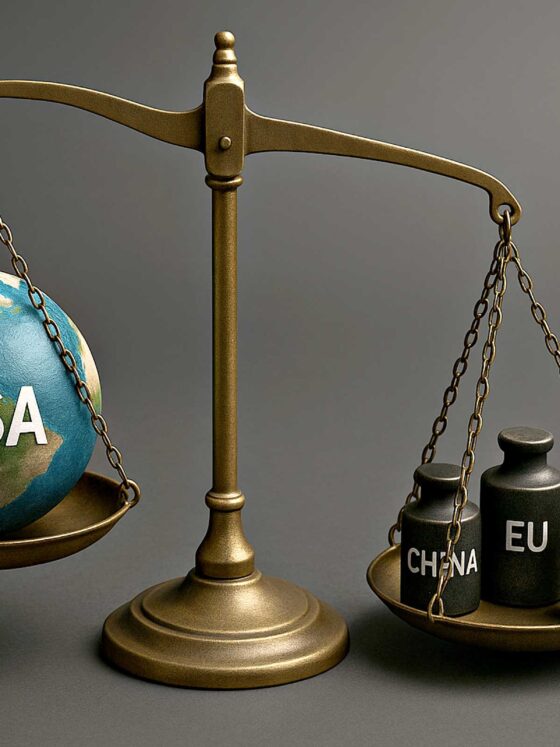
One such consequence is the potential fragmentation of the global economy—likely not the intended outcome of the dominant power. As other countries become aware of their dependence on U.S.-controlled infrastructures, they are beginning to develop alternatives. China’s efforts to internationalize the renminbi and build its own cross-border payment systems are a direct response to the perceived weaponization of SWIFT and the dollar. Similarly, the European Union has explored mechanisms to shield its firms from U.S. sanctions.
Drawing a parallel to the early days of nuclear diplomacy, the authors call for the development of rules, institutions, and doctrines to manage the risks associated with wielding economic statecraft. Without such a framework, the continued use of economic weapons could erode trust, destabilize markets, and ultimately undermine the very foundations of globalization.
Taken together, these developments suggest that the era of unipolar dominance over the economic infrastructure may be drawing to a close. However, whether and when this shift will occur and lead to a truly multipolar economic order remains a subject of fierce debate.
Toward a New Framework
Underground Empire provides a compelling narrative that weaves together multiple topics into a coherent analysis. It leads the read to realize how deeply political power is embedded in the structures of the global economy—and how easily these structures can be turned into instruments of influence and coercion.
This analysis is particularly relevant for policymakers and those with a strong interest in geopolitics, but it also has profound implications for the private sector.
Business leaders have to recognize that the daily activities of their organizations are entrenched in systems increasingly subject to geopolitical constraints. This necessitates not only “traditional” compliance with the likes of sanctions and export controls, but also proactive strategies to anticipate how shifting power dynamics may affect access to markets, technologies, and capital—or, at the very least, a heightened awareness of this evolving reality. In an era where economic infrastructure is a domain of strategic competition, resilience involves more than operational efficiency — it may determine survival.
Share