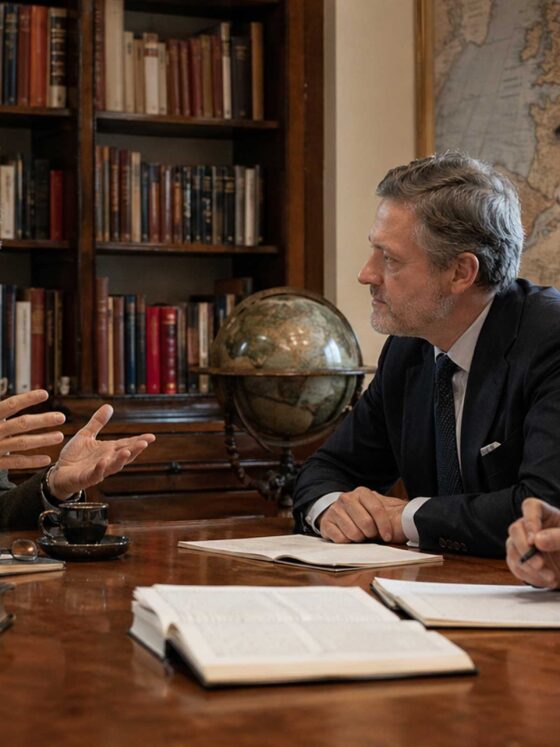
Pietro Meineri, President of the Limes Club Switzerland, and Andrea Aguggia, Treasurer of the Limes Club Switzerland, interviewed Professor Pier Paolo Portinaro, Full Professor of Political Philosophy at the Faculty of Humanities and Philosophy of the University of Turin, member of the Turin Academy of Sciences, and fellow of the Luigi Einaudi Foundation in Turin. During the interview, particular attention was also devoted to the main reflections developed in his latest book, Le metamorfosi degli imperi, published by Solferino in June 2025, with specific regard to the historical and conceptual transformations of the imperial form and to their relevance for understanding current geopolitical balances.
Part II — Europe as an Empire of Law
When I speak of Europe as a possible “empire of law,” I do so with full awareness of the risks inherent in such a formulation. I am well aware that there are grounds for skepticism, and indeed colleagues have challenged me precisely on this point. Nevertheless, I consider the question unavoidable. My own realism has always been preventive in character: realism, in my understanding, should warn against dangerous courses of action, call for moderation, and compel a sober calculation of consequences. What I do not accept is the degeneration of realism into a reductive realpolitik that regards force as the sole and inevitable ultimate resource. Such recourse to force often exacerbates crises rather than resolving them.
The point of departure is the anomalous nature of the European Union itself. If the language of empire has been applied to the European project, this is not because the Union reproduces the classical imperial model of conquest. It is because the European Union constitutes an original political form whose complex configuration has, in certain respects, invited comparison with the Holy Roman Empire. The comparison rests above all on the density of institutional relationships and on a structure that is closer to a confederation than to a federation. Whether one fully accepts this analogy or not, it remains analytically useful insofar as it draws attention to the Union’s structural complexity.
That analogy, however, is ambivalent, and I insist on preserving this ambivalence. On the one hand, it highlights undeniably problematic features: complexity in governance, bureaucratic hypertrophy, slow decision-making, procedural burdens, and the risk of paralysis. These traits recall the institutional sluggishness and eventual decline of the Holy Roman Empire and help explain why many observers doubt Europe’s capacity to act effectively in an environment increasingly shaped by imperial competition. Such doubts cannot simply be dismissed as superficial.
On the other hand, the analogy was also intended to illuminate a positive feature that must not be overlooked: the constitutionalization of relations. This, in my view, is the decisive point. What is at stake is the existence of a constitutional structure capable of guaranteeing rights within a plural and complex order. Even if such a structure primarily protects the rights of its constituent parts—and therefore generates frictions and delays—it nonetheless preserves a juridical form of coexistence that is historically significant. The task, therefore, is not to deny complexity, but to retain and strengthen its constitutional achievements while mitigating its incapacitating effects.
This is, after all, our history as Europeans. The European Union has developed precisely through this mode of construction, and it is unrealistic to imagine that it can suddenly abandon this identity. Whatever path its evolution may take, it will retain the imprint of this confederative and constitutionally mediated formation. Yet the durability of this identity does not mean that the current equilibrium is sufficient. On the contrary, I believe we have reached a critical threshold.
Either Europe makes a serious effort toward greater unification—even in the absence of the conditions required for a fully-fledged federal state—and equips itself with the capacity to operate as a great power, or it risks disintegration. I emphasize “capacity to operate” because economic power alone is insufficient; technological strength alone is insufficient; even the notion of Europe as a “civil power,” though not entirely misguided, is insufficient if it remains unsupported by an adequate political and institutional apparatus. Without such a transition, Europe risks becoming the victim of stronger imperial structures—like a clay vessel caught in the collision of iron pots.
This is the essential meaning of what I call an “empire of law.” By this expression I do not mean a project of domination in the classical imperial sense. Rather, I refer to the preservation and defense of what is specific to Europe’s legal traditions and political forms: first, the great European experience of state formation; and then its reconfiguration within the Union’s complex and confederative framework. This identity must be preserved to the greatest extent possible. Yet it must also be endowed with operational capacity; otherwise, in a world characterized by multipolar competition governed by imperial logics, European unity will not endure.
One may ask whether utility alone is sufficient to motivate movement in this direction. I would answer that the pursuit of utility is indeed common to all processes of development, including both state-building and empire-building. But empires are never reducible to utility alone. They also carry a mission linked to an idea. They do not merely seek to extend material control; they also seek to present themselves as bearers of a civilization that transcends the territorial core of the empire.
In this sense—and without wishing to overstate the argument—I maintain that Europe has, in fact, become the bearer of a civilizing mission, that is, of a civil power. Its action has often been inconclusive or ineffective because the institutional structure has been inadequate to the task, but the vocation nonetheless exists. By “civil power” I mean, above all, the capacity to export the legal model shaped through centuries of European history. The problem is not the absence of a mission; it is the widening gap between vocation and effective capacity.
It is precisely here that Europe, in my view, has deceived itself. The European Union came to believe that this mission could be fulfilled without engaging in serious negotiation beyond the strictly economic and technological spheres. This illusion is deeply rooted in our own history: liberal Europe internalized Montesquieu’s conviction that gentle commerce would replace the barbarism of war. We believed it—so much so that we continued to build economic interdependence, including the gas pipeline relationship with Russia, right up to the eve of the invasion of Ukraine.
This was not merely an economic miscalculation; it was a political misunderstanding of imperial identity. Significant sectors of the German political elite believed that trade, negotiation, and mutual economic interest could neutralize imperial impulses. Yet a subject driven by imperial revanchism is not necessarily willing to exchange what it perceives as indispensable identity recognition for the benefits of commerce. It is here that the limits of the European liberal assumption become fully visible.
The problem becomes even clearer if one considers Europe’s trajectory after 1989. Europe faced a strategic choice: deepening or widening. Deepening would have meant consolidating the founding core into a quasi-federal structure. Widening—driven in part by geopolitical urgency and security considerations—brought into the Union countries with highly differentiated paths of modernization and industrial development. I do not reduce this to a simple mistake; rather, I present it as a structural tension that has shaped the Union’s current difficulties. The choice of widening intensified the challenge of governance without resolving the problem of political integration.
In this context, Germany has occupied a central and particularly burdensome position. After 1989, it became the European actor most deeply engaged in reconnecting economically and politically with the East, while at the same time bearing responsibility for the Western axis of European construction, particularly in relation to France. This dual role has exposed Germany to significant pressures of recalibration. The difficulties in German-Polish relations, as well as the tensions generated by divided historical memories, testify to the fragility of the European political landscape under current conditions.
We must also acknowledge that one of the illusions of the post-1989 period was the expectation of a truly shared European memory, even a cosmopolitanized one. The persistence of divided memories has proven otherwise, and this has particularly affected Germany’s relations with Eastern Europe and, in dramatic ways, with the Russian Federation. Recurrent Russian references to Nazism and the rhetoric of “denazification” are not merely propagandistic episodes; they exert pressure on a country whose confrontation with its past remains constitutive of its political identity.
This pressure interacts with internal polarization, including the rise of sovereigntist and populist currents. The risk is an intensification of the divide between a strongly constitutionalist, Western-oriented political culture and a sovereigntist-populist democratic culture. From the perspective of the “empire of law” thesis, this is a central issue: no legal-constitutional architecture can survive on normative prestige alone if the political and social conditions necessary for its support are progressively eroded.
At the same time, Europe faces growing external pressure from multiple directions: Russia, China, and the United States. For this reason, the issue cannot be reduced to internal institutional design. Europe’s weakness is not merely contingent; it risks becoming structural if Europe does not equip itself with the means to defend and project its legal-political model. A civil power grounded primarily in economic strength cannot assume that interdependence will indefinitely shield it from geopolitical coercion.
For all these reasons, to speak of Europe as a possible empire of law is not an exercise in rhetorical grandiosity. It is an attempt to formulate, in conceptually adequate terms, the challenge facing Europeans today. Europe must preserve the specificity of its legal and constitutional traditions—but preservation alone is not enough. It must also transform that inheritance into operational capacity within a world structured by imperial competition. If it fails, fragmentation and subordination become plausible outcomes. If it succeeds, it may still offer a distinct model of order—one in which power is not abolished (for that would be an illusion), but constrained and shaped, to the greatest extent historically possible, by law.
That, and nothing less, is what I mean by a European empire of law.
You Might Also Like