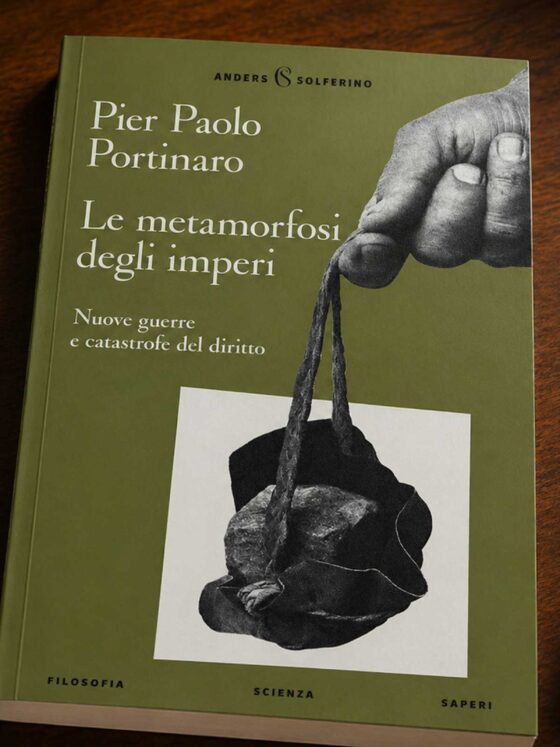
Pietro Meineri, President of the Limes Club Switzerland, and Andrea Aguggia, Treasurer of the Limes Club Switzerland, interviewed Professor Pier Paolo Portinaro, Full Professor of Political Philosophy at the Faculty of Humanities and Philosophy at the University of Turin, member of the Turin Academy of Sciences, and fellow of the Luigi Einaudi Foundation in Turin.
During the interview, particular attention was devoted to the main reflections developed in his latest book, Le metamorfosi degli imperi, published by Solferino in June 2025, with specific regard to the historical and conceptual transformations of the imperial form and their relevance for understanding current geopolitical balances.
Part I — Empires in the international arena: genesis, eclipse, and return
When I state that global history is, in essence, a history of empires, I do not intend to advance a merely rhetorical formula. Rather, I seek to propose a methodological reorientation. The re-emergence of empires at the center of historiographical and political reflection is inseparable from the innovation introduced by Global History, which has compelled us to recognize the genuinely global nature of historical relations. Once this perspective is adopted, it becomes necessary to ask which political forms have, in fact, structured historical processes on the largest scale. My answer is unequivocal: empires.
At the outset, however, a conceptual clarification is indispensable. Our tradition has handed down three principal forms of political and social organization: the polis, the state (and in particular the modern European state), and the empire. Yet political theory has been built predominantly on the first two. Empire has remained, so to speak, in the background. In my view, this has produced a profound distortion in the normative analysis of political phenomena. We have interpreted history through categories that are only partially adequate to the actual magnitude and structure of the power configurations that have shaped it.
This is also why I regard the birth of geopolitics, between the late nineteenth and early twentieth centuries, as a decisive intellectual rupture. Geopolitics was the first discipline to attempt an analysis of international relations freed, at least in part, from inherited conceptual constraints, and capable of reconnecting phenomena that sociology and political science had been treating separately. In this sense, the return of empire is not merely the recovery of a historical object; it is the recovery of an analytical scale adequate to the realities of power, space, and conflict.
If we place empires at the centre of analysis, the interpretation of international relations changes substantially. The major turning points of history—whether in the management of complex problems or in the failure to resolve conflicts involving different ethnic groups—very often concern not small political units in the strict sense of modern state theory, but large imperial aggregates. It thus becomes possible, and indeed necessary, to reinterpret broad stretches of history through this lens. I do not deny the relevance of states; I maintain that a purely state-centered reading is insufficient.
Let us consider, first, the conventional point of departure of the modern international order: the Peace of Westphalia. It is customary to describe post-Westphalian Europe as a system of balance and coexistence among states. This description is not misleading, but it is incomplete. Those entities were frequently animated by imperial ambitions; they generated imperial extensions; and in some cases they continued to exercise roles that cannot be reduced to the logic of equal sovereign statehood. Moreover, alongside the European state core, we find formations such as the Tsarist Empire and the Ottoman Empire, which possess unmistakably imperial characteristics and do not fit neatly into the model of the modern European state.
Accordingly, the supposedly homogeneous Westphalian order appears, upon closer inspection, far more heterogeneous. Even contemporaries were aware of this. My criticism does not go so far as to claim that seventeenth- or eighteenth-century actors genuinely believed all political entities to be equal in status and power. They were well aware, for example, of the anomalous nature of the Holy Roman Empire. From Bodin onward, the question was already being posed in explicit terms: where is the sovereign? where is the state? Such questions reveal that the neat retrospective image of an orderly and uniform interstate system is itself a simplification.
The very problem of sovereignty leads us to the issue of state formation. Political science, when historically grounded, reminds us that the state is constituted through the acquisition of a dual monopoly: the monopoly of force and the monopoly of taxation. This is an operation of coercion before it becomes a juridified order. States arise through usurpation, war, submission, and pacification, and only subsequently undergo a gradual process of juridification. For this reason, even statehood itself must be interpreted through the duality that German doctrine has expressed so effectively in the distinction between Machtstaat and Rechtsstaat.
This duality is essential for understanding both the history of states and the development of international law. But before returning to that issue, let me emphasize the imperial reading of the great twentieth-century ruptures. The end of the First World War was not merely the conclusion of a conflict among states; it marked the collapse or disintegration of at least five empires: the Tsarist, Ottoman, Austro-Hungarian, German, and British empires. This is not a marginal observation. It is a key to understanding the subsequent reconfiguration of international relations, including the long and unresolved crises generated in regions such as the Middle East, where the collapse of Ottoman and British imperial frameworks produced power vacuums later filled by ethnic and religious tensions.
Nor is this imperial perspective limited to 1918. The French Revolution undoubtedly disrupted the Westphalian equilibrium, but the Napoleonic episode must also be read as an attempt to redefine Europe through an imperial project. German revanchism in the interwar period may likewise be interpreted as the reaction of a defeated empire seeking restoration through revenge. Thereafter, bipolarism emerged in the form of two great empires—the Soviet Union and the United States—which dominated the Cold War order. Seen in this way, the twentieth century does not represent the disappearance of empires; rather, it represents their transformation.
After the collapse of the Soviet Union, many indulged in the illusion of a unipolar world. I have always regarded that unipolar dream as unrealistic. Already in the early years of the new millennium, it was proving incapable of stabilizing the global framework. It is against this background that I interpret what is occurring on the eastern flank of Europe: Russian aggression as the revanchism of a defeated empire seeking to reaffirm an identity shaped in the Tsarist era and intensified during Soviet imperialism. This is precisely why the category of empire remains indispensable for interpreting the present.
The same category is indispensable if one wishes to understand the crisis of international law and, in particular, international humanitarian law. Here again, I insist on avoiding the distorting effect of reading history exclusively through the categories of polis and state. Modern international law—from Gentili through Grotius and Pufendorf, from the age of Westphalia to the early twentieth century—is a construct that developed within the age of states. It is therefore shaped by the constitutive duality of statehood itself: power and law, coercion and juridification, Machtstaat and Rechtsstaat.
After the Second World War, a significant turning point occurred. International law, building upon its previous foundations, progressively assumed the form of international humanitarian law. The crucial novelty was that the subjects of international law were no longer states alone, but also individuals as bearers of fundamental rights. This represented a major civilizational achievement. Yet, in my view, it also contributed to an underestimation of the role of power (Macht) in international relations. We effectively persuaded ourselves that international humanitarian law could function even where the decisive actors were not merely states governed by the rule of law, but entities acting according to power interests in a distinctly imperial sense.
In other words, we failed to recognize adequately that international order is always, in some way, guaranteed, dominated, and shaped by actors of an imperial nature, within whom the element of power ultimately prevails over the element of law. One may rightly object that there have been periods in which imperial power was tempered by law—British imperialism in certain contexts, or the American Pax after the Second World War. I accept this qualification. But it does not hold universally, and Carl Schmitt’s observation remains instructive: a more regulated center can coexist with a less regulated periphery. The existence of juridified zones does not abolish the imperial logic structuring the whole.
Today, however, I believe we are witnessing a phase of regression. We are not entering a stable multipolar imperial order; rather, we are living through a phase of global disorder centered on empires. This distinction is crucial. A multiplicity of powers does not in itself generate order. On the contrary, the proliferation of asymmetric and hybrid conflicts is producing a radical delegitimization of international law and, more specifically, a genuine catastrophe for international humanitarian law.
You Might Also Like