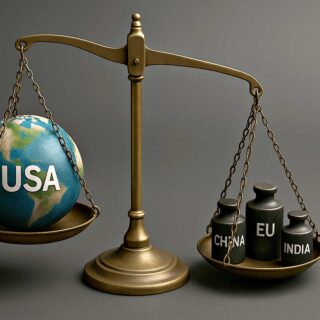
Trump’s protectionism is unparalleled in the last century, but the ground on which it takes root has been ploughed by Biden. The point on the trade war. The self-harming collateral damage. Tariff man embodies the US rejection of the American century.
Published in Limes issue: America Contro Europa (America Versus Europe) – n°3 – 2025
No matter how far back in time one looks, the brutal treatment that Donald Trump and his vice-president J.D. Vance publicly subjected the Ukrainian president Volodymyr Zelens’kyj to in Washington on March 1st, 2025 is unprecedent. On the other side, we have to go back about a century to find a US administration that applied tariffs comparable to those imposed by Trump on Mexico, Canada and China – the United States’ first, second and third largest trading partners respectively. A flat tariff of 25% on all goods imported from Mexico and Canada – 10% for Canadian oil – plus an additional 10% on imports from China, which are already heavily taxed, is an unprecedented move since the end of the Second World War. The exception is set to become even more blatant with the possible 25% duty on imports from the European Union proposed by the White House, despite a not so unbalanced trade balance.
Just one week after the announcement, in his classic ‘negotiating’ style, Trump pardoned Canada and Mexico for a month after seeing what effect tariffs had. The effect was a shock, amplified by the simultaneous withdrawal of US aid to Ukraine and by the extent of the reactions. Among the most significant: a 15% Chinese counter-duty on US agricultural and livestock products; Canada’s announced retaliation on over 130 billion worth of imports from the USA 2; similar tariff measures (25%) decided by Mexico on its vast import of US goods 3; the sharp decline on the world’s main stock exchanges of almost all companies (American and others) likely to be affected, including those in the technology, medical, financial, retail, energy, manufacturing and telecommunications sectors 4; the open questioning by large investors of the ‘dollar as a safe haven, now a real possibility’ 5.
The tariffs are officially aimed at countering what Trump has called ‘extraordinary threats to the security of Americans’, including ‘the entry of illegal immigrants and the health crisis due to Fentanyl’ (a powerful synthetic opiate) 6. Imports from these three countries were already subject to tariffs that in some cases equalled or exceeded the new levels; but the measures were limited to very specific categories of goods, so much so that the average tariff on 94% of imported manufactured goods did not exceed 2% 7.
The flat tariff, a sort of customs atomic bomb, changes the scenario. The proof is in the immediate exemption of cars (before the one-month suspension announced on 6 March), so as not to ruin American manufacturers who use Mexican components like there’s no tomorrow. But also in the exception for Canadian crude oil, subject to a 10% duty ab origine so as not to burden the US energy bill too much. In 2024 the US imported 60% (4 million bpd) of its oil from its northern neighbour 8. In comparison, the 450,000 bpd imported from Mexico (and taxed at 25%) is a small amount, even if a prolonged imposition would harm US refineries, which are now calibrated on American heavy oils and no longer on light crude from the Gulf, which today mainly supplies Asia. As a precaution, the soft tariff has also been applied to Canadian gas and electricity, even though they only account for 1% of US consumption. Mexico, on the other hand, imports 70% of its gas and a similar share of its refined petroleum products from the United States 9, so for it energy is a constraint and not a bargaining tool.
Canadian nickel and aluminium are equally difficult to replace, accounting for 50% and 60% of US imports respectively 10. Domestic extraction and refining capacity (especially for nickel) is scarce. Indonesia, a potential alternative supplier that Washington has already set its sights on under Biden, has an extractive sector dominated by Chinese operators, while Ukraine – despite the great fanfare over the mining agreement – promises less than it flaunts 11, at least in the medium term. Russia could become accessible again if relations normalise, while Greenland is little more than a hypothesis and China is the competition to be freed from (decoupled from).
- Tariffs are bad for the US economy, as many Americans know(graph 2). The bulk of their cost is passed on to households in the form of higher prices for imported goods and for domestic goods shielded from competition: an estimated12, or about $1,200 per family for average incomes. Duties are in fact a tax on imported goods and services, so importers tend to pass them on to consumers by raising prices. And it is essential that they do so: the purpose of the measures is to make domestically produced goods artificially more competitive, so imported goods have to become more expensive. However, domestic producers are also forced to raise their prices, as long as they remain lower than those of imported equivalents, so the consumer pays twice.
If all goes well, the extra profits accumulated by domestic producers are then invested in greater production capacity and – if automation does not increase too much – in new jobs. For those goods, especially those with a low to medium added value, that the United States cannot (or can no longer) produce in sufficient quantities and at suitable costs to satisfy domestic demand, tariffs instead result in mere price increases. This is the case for the import of exotic goods such as bananas, coffee or avocados; but also – to stay with commodities – for many strategic minerals. Until the 1980s, the Rocky Mountains were one of the main areas for the extraction of rare earths and metals, but with the quantities demanded by the market today and the Chinese economies of scale, it is unthinkable to repeat this exploit.
This is another reason why it is very difficult for tariffs to represent a significant source of income for the federal treasury in a large and complex economy such as the US. As Trump would like, he aims to use the revenue to finance tax relief without increasing the debt. Tariffs become is in fact a tax on expenditures, which much more regressive than the national tax system: it weighs proportionally more on low incomes, reducing their already limited spending power and increasing their welfare needs, with strong implications for social justice. In 2024, the federal government collected approximately 2,500 billion dollars in personal income taxes; to equal this sum, the universal tariff would have to be close to 80% 13.
Tariff protectionism thus becomes an excuse to avoid more structural and incisive measures that tackle the problems of the American economic model head on: a more redistributive tax system, a less exclusive and inefficient health system, a limitation of the excessive lobbying and oligopolistic power of large corporations, and better training of the workforce 14. The federal budget deficit – 1,830 billion dollars in 2024: 4,920 billion dollars in revenue minus 6,750 billion dollars in expenditure 15 – is mainly fuelled by growing outlays for Social Security (pensions) and Medicare (health care for the elderly). The other item on the increase is debt servicing (interest): kept in check by the low yields of T-Bonds (so far?) considered a safe haven, but fuelled by a debt whose explosion is due to decades of tax cuts that prevent the tax authorities from keeping up with public spending. Federal agencies in the crosshairs of the infamous Doge (Department of Government Efficiency) have a relative and constant impact on this expenditure: 16.
Tariffs, however, the White House argues, fix the trade deficit and restore manufacturing capacity, thus bringing money to the treasury (in the form of taxes and consumption taxes) and resuscitating the middle class. If only. High and generalised tariffs, if prolonged, in fact not only reduce imports but also exports, leaving the trade balance almost unchanged. This is because many Made in USA products – such as the legendary Chevrolet Silverado, one of the best-selling pick-ups in the United States 17 – are made up of parts made elsewhere, which become more expensive, making the final product less competitive on foreign markets. Also because trading partners readily apply countermeasures, as happened in early March.
Tariffs of this magnitude also boost the value of the dollar. This is partly due to the deliberate actions of major trading partners such as China, which manipulate their exchange rates: in 2018, during Trump’s first round of tariffs, the renminbi fell 10% against the dollar. Partly due to automatic mechanisms: countries use part of the proceeds (in dollars) from exports to the United States to purchase goods, but if tariffs reduce these proceeds and consumption of certain Made in USA categories does not fall (think of chips or certain commodities, where demand is relatively inelastic), they will have to buy dollars on the market to pay for them. The increased demand for dollars strengthens their price (exchange rate) on the currency markets, further penalising American exports.
In 2018, the people most affected by these dynamics were US farmers and ranchers, whose losses were such that the first Trump administration provided them with emergency subsidies worth 61 billion dollars, almost equivalent to the revenue from the tariffs. Who knows if Elon Musk would approve. Boeing, on the other hand, which before that round of tariffs made 25% of its turnover in China, saw its 737 replaced by the C919 of the Chinese company Comac. Something similar is happening with semiconductors affected by the Biden administration’s export restrictions, although not – yet – on this scale.
- Why then is the Trump administration so fond of tariffs?A first answer, true but partial, is that Donald Trump reasons in a counterfactual (often non-factual) way, on average uninformed and strongly maximalist. He hates details and loves simple solutions, even if they are potentially counterproductive, fully in line with the logic of his electorate who vote for him and support him wholeheartedly. It’s a purely political calculation: because he’s focused on immediate electoral returns, but also because he mobilises people with a view to a strongly ideological end (‘make America great again’), which like all ideologies seduces also and above all because it’s abstract.
Trump has vast institutional powers and a favourable cultural climate on his side. The US Constitution entrusts Congress with the authority over taxes and foreign trade, and until the New Deal the parliament jealously guarded this power. In 1824 Senator Henry Clay ran for president with a strongly protectionist agenda aimed at financing the material development of the young republic with the proceeds from customs duties: an idea that would survive the electoral defeat of its author. After the defeat of the agricultural states of the South – mostly opposed to protectionism – in the Civil War (1861-1865), the Republican Party promoted a wave of tariffs to replenish the treasury bled dry by the conflict and protect Northern manufacturing. William McKinley, president from 1897 to 1901 (the year of his assassination) and often mentioned by Trump (especially after his attempted assassination), was a parliamentarian and one of the main supporters of the Tariff Act passed in 1883 18.
In 1930 Congress passed the Smoot-Hawley Tariff Act, which imposed duties on thousands of foreign products in an attempt to protect domestic agriculture from the post-war recovery of European production (and therefore competition) and the consequent fall in prices, but also to stem the insolvency of farmers with bank loans. The result, as we know, was a devastating trade war that precipitated the Great Depression, worsening and prolonging it for a whole decade.
Just two years later, with the election of Franklin Delano Roosevelt, the wind changed. The Democratic president advocated a concept of international commerce based on agreements between countries to promote trade, a practice that would inform the ‘American moment’ from 1945 onwards. In 1934, after a long parliamentary tug-of-war, the Reciprocal Trade Agreements Act was passed, authorising the president to negotiate bilateral agreements and impose tariffs of up to 50% by means of executive orders, thus bypassing Congress. Ironically, at the time it was the Republican opposition that denounced the delegation of power to the president in commercial matters as excessive. However, in 1962, at the height of the Cold War and the competition with the USSR for spheres of influence, Republican votes in Congress helped to pass the Trade Expansion Act advocated by (Democratic) President John Fitzgerald Kennedy, which further expanded presidential powers over tariffs and trade agreements.
The new change of direction saw the decisive contribution of another Democrat. Joe Biden intensified Donald Trump’s protectionism, adding an impressive apparatus of sanctions (especially against Russia) and export restrictions (especially towards China) to the tariffs. The Biden administration is the first since the Kennedy era not to negotiate any major trade treaties, doing even less than the first Trump, who despite calling himself the ‘Tariff man’ renegotiated NAFTA (North American Free Trade Agreement) with Mexico and Canada and signed a free trade agreement with Japan.
During the Biden presidency, the political and strategic turning point of which the second Trump is the complete and draconian expression, is coming to fruition. The prime mover of ‘hyperglobalisation’ which saw international trade increase by 60% in the twenty years from 1990 to 2010, and the forge of a consensus that sees the opening of markets as a one-way street, America began to theorise the urgent need to reverse this approach because it was no longer in its national interest 19. It does so with high-profile figures such as former Trade Representative Katherine Tai and former National Security Advisor Jake Sullivan, whose positions are in line with those of figures such as Robert Lighthizer, Tai’s predecessor in the first Trump administration.
International economic relations, like the broader geopolitical order of which they take part, need an organising power. This is demonstrated by the example – the latest in a long series – of the Great Depression, the duration and severity of which were largely due to the declining ability of the United Kingdom to act as a hegemon and the immaturity of the United States called upon to take its place.20 From 1945 to the present day, through the various crises – the Latin American debt crisis in the 1980s, the dot.com crisis in 1997, the Asian crisis in 1998, the economic and financial crisis of 2008, just to mention the major ones – produced by US-style transnational capitalism, America has played this role because convinced it would benefit from it. Today we are paying the price for the United States’ sudden and angry unwillingness to act as a stabilising factor, which makes them a barometer of a world in turmoil. A stormy world because it is leaderless, given that not even China – the only candidate for (co)management of the global economy, due to its size and capacity – appears willing to take the helm, stubbornly pursuing a deflationary policy that exports production overcapacity and exacerbates trade tensions.
- Seen in the light of the moment, Trump’s tariffs reveal their full significance.They are not only a negotiating tool to change America’s terms of trade with the rest of the world, but also an instrument to transform the still crucial role of the United States in the global economy and finance into a means of influence and coercion in the game for resources, markets, technological supremacy and alliances. In short: a weapon to be used without reservation in geopolitical competition, both within and beyond the purely economic and commercial sphere.
Over the last twenty years these measures have been mainly directed against America’s adversaries: countries such as China, Russia, Iran, Venezuela and North Korea. Today we see them being extended – or the threat of extension – to partners and allies: from Canada to Mexico, including European and Asian ‘friends’. In doing so, Trump is perhaps (unconsciously?) laying the foundations for a structural change in the geo-economic order that will relativise the US position, favouring the emergence and strengthening of new blocs, especially in Asia. We’ve had a generous taste of this in three years of sanctions on Moscow. These have certainly damaged the Russian economy, but they have led to the unexpected circumvention of the economic and financial networks dominated by America: the SWIFT interbank system, the credit card circuits, the rating agencies, the dollar.
The Mexican case is a litmus test. Decades of commercial integration, combined with recent American efforts to decouple from China, have made Mexico the USA’s main trading partner. Well before Trump was re-elected, the Mexican government had clamped down hard on the migrants – mostly South Americans – who cross its territory heading north, detaining 475,000 people in the last quarter of 2024 alone and causing border crossings to plummet to an all-time low 21. At the same time, it has begun to crack down on the production and trade of narcotics (especially Fentanyl) and has imposed a 35% duty on clothing imported from China (its second largest trading partner), targeting Chinese online sales giants such as Temu and Shein.
Mexico relies on help from Washington to repress trafficking, but also on the tax revenue from the approximately three thousand maquiladoras (factories) that dot the area on the border with the United States, which have proliferated since the 1990s (NAFTA came into force in 1994). This legal economy is an insufficient but tangible barrier to the crime that thrives in the North due to its proximity to the US market (drugs, weapons, migrants). The approximately one million people employed in border establishments are labourers taken away from the cartels, while the spectre of recession (22) evoked by the tariffs is a strong political and economic disincentive for the Mexican government to cooperate. It is no coincidence that shortly after the announcement of the tariffs, Mexican President Claudia Sheinbaum – albeit with the caution of someone who knows they are the weaker party – declared that ‘Mexico could look for other trading partners’, a not too veiled reference to Beijing 23.
This is true for Mexico. But also for all the others, adversaries and otherwise, who, depending on the case, watch with amazement, dismay or pleasure – or a mixture of the three – the (self-)demise of the American-centric order.
Share