“Resistance axis” is a term that emerged in the geopolitical discussion on Iran in 2002. The at-the-time president of the United States George W. Bush had claimed that Iran, Iraq and North Korea formed an axis of evil. The Libyan daily newspaper Al-Zahf Al-Akhdar countered this statement in an article reading “the only common denominator among Iran, Iraq, and North Korea is their resistance to US hegemony”.
But the idea of a belligerent, dangerous and terrorist Iran goes back decades. At the basis of this understanding is a narrative of Iran as a threat to the region’s stability and securitization, especially due to the efforts it takes on foreign soil to support non-state actors attempting to build a network of influence across the region.
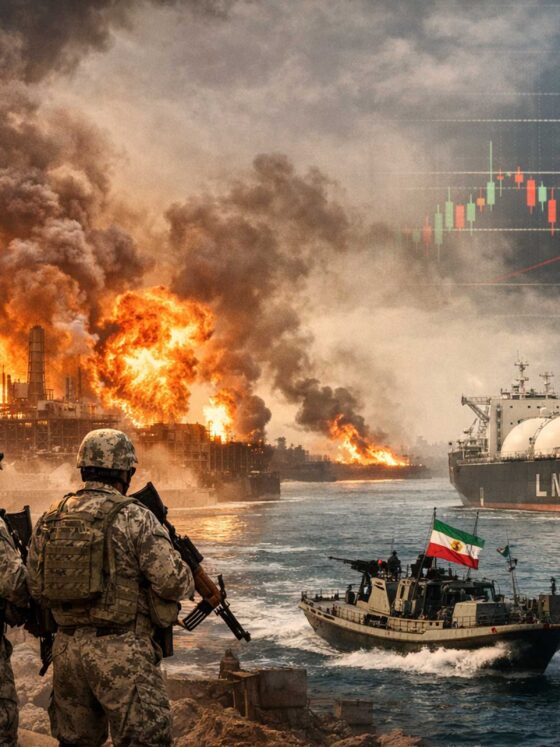
Iran’s regional policy, however, is slightly more complicated than this. With the recent attack on Iran by the USA and Israel and Iran launching missiles towards the Gulf states in response, a slightly more critical look on the history of Iranian relations with the Arab world helps to shed light on how we got here.
From the revolution to the Iran- Iraq War (1979 – 1981)
The main goal was to establish an alternative, Islamic foreign policy which would also favour Iran as the main regional power and would be “based on Islamic criteria, fraternal commitment to all Muslims, and unrestrained support for the impoverished people of the world”, as article 3.16 of the Iranian constitution at the time read.
At the core of this vision lies the rejection of Western and Communist-bloc alliances in the Middle East and the export of the revolution.
Perhaps the most successful case for Iran was Assad-led Syria. In the run-up to the revolution, the Assad dynasty provided diplomatic protection to key revolutionary figures, including Khomeini, the father of the revolution. Unsurprisingly, Syria was the first Arab country to recognise the new government in Iran. The sympathy between the two countries originated from the shared vision of commitment to the Palestinian cause and common stances towards regional neighbours, most notably Saddam Hussein’s Iraq and Lebanon. The latter had capitulated in the civil war in 1975, with various international actors’ agenda exacerbating local rivalries. On one side, Iran was supporting Hezbollah. On the other, Saudi Arabia stood with the PLO, Israel and Sunnis, Christians and Maronite Christians movements.
On the opposite side of the spectrum was the Kingdom of Saudi Arabia, concerned about the regional status quo. At first, both countries tried to demonstrate unity and recognition, but that was short-lived. Soon Khomeini started accusing the Kingdom of being “corrupt and unworthy to be the guardians of Mecca and Medina”, two crucial cities for the Muslim faith both lying in Saudi Arabia. The Saudi King, from his side, stated that Iran was full of “hypocrites and pretenders who are using Islam to undermine and destabilise other countries”.
Religion did play a role in this conflict, but it was hardly the sole explanatory factor. Among others, competing claims over Greater and Lesser Tunbs – a group of islands in the street of Hormuz administered today by Iran – and US troops in the Saudi Kingdom were the main points of contention.
The Iran – Iraq War (1981 – 1988)
The escalation into the Iran–Iraq war (September 1980 – August 1988) resulted in Iran’s isolation. The Arab world mainly took a pro-Iraq line, partially due to the strong hard stand Iran took in the international sphere.
At this time, Iran pursued a three-point regional strategy: defeat Iraq’s military, distance Baghdad from the Gulf states, and emerge as an influential player in the Gulf.
The list of enemies by 1987 was long: Iraq, Kuwait, Saudi Arabia, Sudan, Egypt, Israel, Jordan, Morocco, Tunisia, North Yemen, and Afghanistan. South Yemen and Libya remained in friendly relations, and Syria was the only ally to Tehran and the only Arab state to have a security alliance with Iran.
Syria would provide logistical assistance in exchange for Iranian oil, support in front of the international community. Among other things, this meant seeking to contain power on its eastern border with Iraq and, more broadly, limit the influence of the USA, Israel, and the Gulf monarchies.
So, the Levant assumed a key role. Building on the alliance with Syria, Tehran could exploit the politicization of the Shi’a population in Lebanon. In this context, Hezbollah was formed and Tehran succeeded in capitalising off the deployment of arms to the Shi’as, which guaranteed Iran a foothold on the Mediterranean coast. Behind the emergence of Hezbollah lay the stipends, aid recruitment, weapon development and training sponsored by the Iranian military. Moreover, wanting to move away from the Israeli-Iranian alliance era pre-1979, Tehran embraced the Palestinian cause in two ways: first by framing the conflict as a wider Arab struggle against Israel, and second by supporting Palestinian radical factions, particularly those endorsed by Syria.
The increasingly pro-active Iranian policy in the region also spilled over to the Islamic Front for the Liberation of Bahrain (IFLB). While unsuccessful in toppling the government, the IFLB was successful in fuelling fear of Iranian meddling. In Bahrain, that fear was used to justify violent protest crackdowns, framing opponents as agents of Iran, even when protests were directed at government corruption and stagnating economy. This narrative went so far as to be the ground for accusing Iran of funding “Bahraini Hezbollah”, a group allegedly behind terrorist acts across Bahrain, and to be the justification for further suppression of political expression.
In the Gulf, this perception of Iran as a security threat pushed neighbouring states to cooperate. In 1981, the Gulf Cooperation Council (GCC) was established to put down ground rules. Saudi Arabia managed to use this cooperation to secure immediate military access to Bahrain, if needed.
On the other side of the Arab peninsula, in Yemen, Hussain Badr al Deen Al-Houthi was becoming a relevant figure. While not yet holding any political role, he travelled to Tehran in 1986 – a premonitory action to the close ties that would later be consolidated between Tehran and the Houthis.
The end of the Cold War (1998 – 1990)
In 1988, Iran’s regional policy shifted to accommodation. In this line of thinking, Iran took the decision to end the eight-year war with Iraq, unconditionally accepting the UN Security Council Resolution (SCR) 598, a year after its unanimous adoption. The resolution urged for an immediate ceasefire, repatriation of prisoners of war, and withdrawal of both sides to their internationally recognised borders.
By this, Iran did not only renounce the stated goal of defeating Iraq and signal that discussions could be opened on security cooperation on a regional level, but it also re-positioned itself vis-à-vis its neighbours. Most notably, Saudi Arabia, stuck between the secular Saddam Hussein and the expansionist Khomeini, at last concluded that the former was more concerning than the latter and began to consider working with Iran as a counterweight to Iraq. When Iran was hit by a devastating earthquake killing an estimated 300.000 people, Saudi Arabia sent aid, and diplomatic relations were restored.
In 1989 Ayatollah Khomeini, founder of the Islamic Revolution died. With his passing, Rafsanjani was elected president.
In 1990, the Taif agreement was signed, ending the fifteen-year-long civil war in Lebanon, sponsored by Saudi Arabia and Syria. Fearing marginalisation from its loyal Syrian ally as it approached Saudi Arabia and loss of influence over Lebanon, Iran decided to cooperate. The stabilisation of Lebanon under Syrian hegemony also came with a fundamental role accorded to Hezbollah in Lebanese politics and in the resistance against Israel. It was thanks to this accord that Hezbollah transformed from a guerrilla organization into a political force.
Kuwait invasion and Israel (1990 – 1997)
In August 1990 Iraq invaded Kuwait, bringing to the forefront what – in Iran’s eyes – was the reasoning behind the country’s policies toward Iraq in the 1980s.
And indeed, all Gulf countries saw it as well: Iran’s regional profile was raised and new communication channels were opened, specifically to create ties to collectively secure the Gulf. However, this crisis also caught the attention of the Western world, who returned to the Gulf.
Completely in contrast to the interventionist anti-Western position held post-revolution, Iran remained neutral, supported the UN role and stood on the same side of the West, calling for the restoration of Kuwait’s sovereignty. Iran was now also aligned with many of the Arab countries it had been at odds with before: Jordan, Tunisia, Saudi Arabia, Egypt, and Morocco, with which diplomatic contacts were taken.
The biggest success for Iran was Iraq’s total capitulation. The SCR 598 was fully implemented, settling their border dispute, but most importantly the UN recognised Iraq as the “aggressor” in the Iran-Iraq war, allowing Iran to claim for war reparation in the billions of dollars.
While its long-standing conflict with Iraq was won, the dynamics on the Arab-Israeli front were chaining, and not in the direction Iran had hoped for. With Arab states and Israel negotiating directly for the first time in Madrid in 1991, Iran was concerned that its room of manoeuvre would be restricted. Additionally, the conference heightened Iran’s sense of isolation in the Gulf, as in 1993 many GCC states established communication and trades with Israel. Nonetheless, Iran opted for neutrality, declaring its opposition to the peace process but without acting on it.
In this period, Tehran and Sunni Islamist groups in Palestine had grown closer, finding many similarities in their religious ideology and in their shared anti-Israel politics.
Mohammad Khatami and foreign invasions (1997 – 2011)
In 1997, elections took place and Mohammad Khatami became president. He could rely on a personal long history of good relations with Saudi Arabia and the Shi’a community in Lebanon, which he used to improve Iran’s regional positioning. The quote he is remembered by is the “dialogue of civilizations” – including but not limited to the United States – he called for in 2001 at the UN.
Khatami was also the first president to visit Saudi Arabia since the 1979 Revolution, reciprocated by a visit of the Saudi Crown Prince to Iran and the signing of several bilateral deals.
Then came the US invasion of Afghanistan. Iran at first cooperated with the US to overthrow the Taliban regime. When the Bush administration accused Iran of supporting terrorism via an “axis of evil”, Iran left Afghanistan. A strategy of containment of Iran’s influence in Afghanistan was pursued at this point by Saudi Arabia and Pakistan.
After that, it was Iraq’s turn. In 2003, the US invaded Iraq and toppled Saddam Hussain. It was an opportunity not to miss for Iran to create a new partnership with its neighbour, supporting Shi’a militia groups to counter the US and extremist Sunni Islamist groups, which had ruled under Saddam’s time in power, and building ties with various political parties. Saudi Arabia was also on the lookout to capitalize on the fragmentation to increase its influence on Iraq, yet another point to add to the list of grievances between Tehran and Riyadh.
Surprisingly, perhaps, the framing of Iran as an “existential threat” to the Middle East did not originate from Saudi Arabia, but from Jordan. It was King Abdullah II of Jordan who in 2004 coined the idea of a “Shi’a Crescent”, an ideal arc stretching from Iran into Iraq, Syria and Lebanon that would “alter the traditional balance of power between the two main Islamic sects and pose new challenges to U.S. interests and allies”, as he stressed in an interview with The Washington Post. Much of the countries in the region got behind this narrative. In Bahrain, the minister of foreign affairs, seizing the moment and building on the long history of capitalising on the rhetoric of a dangerous Iran, took the argument even further. Increased freedom of speech and assembly, according to him, also meant increased room of manoeuvre for Iran to boost its influence. In his words “when you give people more freedom, bad groups can exploit this freedom for their own sectarian purposes”.
Iraq was not the only country descending into violent conflict; so was Lebanon. The thirty-four-day war between the Israel Defence Forces (IDF) and Hezbollah in 2006 saw Iran once again isolated, notably by Saudi Arabia, Jordan, and Egypt. All three opposed Israel, but all three thought it was best to weaken a key Iranian ally rather than risking its rising in popularity. That being said, once the war ended, Saudi Arabia provided $1.2 billion for the reconstruction of Lebanon. Iran sent a total of $120 million. Both countries accompanied their financial support with campaigns to boost their political reputation in Lebanon.
Beyond Lebanon, in the late 2000s, Iran also sought to increase its influence in Yemen, through military professionals, development experts, spies and media consultants. It was at this point that rumours started to spread about the Houthis being financed by Iran, with Yemeni state-controlled outlets condemning Iran.
The Arab Springs (2011 – 2016)
The protests that started to emerge in early 2011 across the Middle East and North Africa were seen by both Riyadh and Tehran as yet another chance to redraw regional balance in their favour, damaging the other image in the process.
Allegations of Iranian involvement in Bahrain uprisings were advanced by the country’s regime aiming to diminish the power and reach of the protests. Independent inquiries found no evidence of such involvement, but little did that matter: backed by Sunni theologians and politicians and reinforced by the idea that Sunni-Shi’a hatred dated back to ancient times, this narrative gained prominence. Rather, it was Saudi Arabia who intervened on the side of the regime, crashing democratic aspirations in the name of impeding further Iranian influence.
Saudi officials came to condemn Iran as the region’s largest state sponsor of terrorism, responsible for political instability in the Arab world: a message whose appeal expanded beyond the MENA region, reaching the United States and the United Kingdom.
Simultaneously, Saudi Arabia was distributing billions of dollars to the Lebanese government as it was facing sectarian conflict between the Shi’a Hezbollah and the emergence of Sunni political movements, all while executing Shi’a leaders within its own borders. As a Saudi diplomatic mission was in Iran in 2016 to discuss exactly this topic, the Saudi embassy in Tehran was stormed in protest. In response, Saudi Arabia broke off relations with Iran and Lebanon, as the latter’s government did not express condemnation to Iran for the violence.
In Syria, Iran reasoned that it was imperative to maintain the Al-Assad dynasty in power, in line with the fundamental agreement between the two countries to preserve security. Iranian involvement came to include ground forces stationed in Syria and, in 2014, the establishment of the 4+1 coalition, formed by Iran, Iraq, Russia, the Syrian government, and Hezbollah – the +1 in the equation – to cooperate to defeat terrorist groups.
In the same year, Iran invested in two other key actions: training programs for Houthis fighters and fighting ISIS in Iraq.
The former quickly proved to be unsuccessful, also owing to Yemeni suspicion towards Iranian trainers. However, a solution was found just as quickly: Hezbollah fighters were appointed trainers. In neighbouring countries, this resulted in a campaign framing both Iran and the Houthis as an existential threat to Yemen and the wider region. In 2015, led by Saudi Arabia, the gulf monarchies invaded Yemen with the goal of pushing out the Houthis and re-establish Yemeni government’s full control. Nonetheless, there is only evidence of small-scale weapons trade between the two, rather than a direct, large-scale supply from Iran. Moreover, the Houthis are far from dependent on Iran’s decisions: the Iranian advice left unheard not to take over the capital Sanaa in 2014 is perhaps the most remarkable instance.
Regardless, early in 2015, a new air route between Tehran and Sanaa was opened by Iran Air, and the ties between Tehran and the Houthis kept on growing as the conflict escalated and internationalised.
The latter saw the cooperation of Iran’s special external operations force – the Qods Force – and Shia volunteers with American airpower. Why? For one, ISIS was posing a great threat to the longtime ally Assad in Syria. Related and on top of that, ISIS emerged as a vehement anti-Shi’ist force, which Iran feared it would weaken its regional standing. When in 2016 ISIS was defeated in Mosul, their Iraqi capital, Iran’s Islamic Revolutionary Guard Corps (IRGC) could claim victory and present itself as a security provider both for Iranians and for the Iraqi Shi’a community.
Today (2015 – 2026)
In 2015 Iran and the USA were also having nuclear talks and signed the Joint Comprehensive Plan of Action, better known as JCPOA. In exchange for sanctions relief, Iran would restrict its nuclear program – something it had already agreed to do in 1970 as a signatory to the Nuclear Non-proliferation Treaty, but the argument was that the after the 1979 revolution development in technology and expertise continued in Iran in secret. It only lasted three years; in 2018 Donald Trump withdrew from the agreement.
With the JCPOA compromised by the main party who had pushed for it signing, fear over Iran nuclear capabilities grew among Arab states. And so, they turned to the other nuclear state in the region, Israel. The 2020 Abraham Accords are the peak of this new alignment: normalisation, security and intelligence support at the price of ignoring the Palestinian cause.
In this context, in 2023 Iran sought to finally end hostilities with Saudi Arabia on Yemen: relations between the two would be normalised in exchange for Iran’s agreement to cease its military support for the Houthis. At the moment, this deal is still in place.
Vali Nasr, author of “Iran’s Grand Strategy: A Political History”, writes “if the goal of the Axis of Resistance was to marginalize and weaken Israel, it seemed to have achieved the opposite”. Perhaps nothing proves this point more than the aftermath of the 7th of October 2023 and the 12-day wars in the summer of 2025. If the success of Hamas attack on the 7th of October 2023 seemed to point in favour of the axis, the killing of Hezbollah leader’s Nasrallah and the overthrowing of Basahr al-Assad in late 2024 point in the opposite direction. Israel could then build a direct bombing campaign against Iran, citing regional chaos, destabilization and nuclear threats.
As history evolves before us, Iran is, without a doubt, a country with a strong and determining geopolitical role. However, the image of a constant threat to fear not only does injustice to history but it also deters and nullifies any diplomatic effort, which is how we got to the February 28th attack and the escalation into a regional war.
Share