In December 2024, the armed coalition led by the Islamist militant group Hayat Tahrir al-Sham (HTS) and the Turkish-backed Syrian National Army (SNA), put an end to the Assad regime in just 10 days. It was a historical and political earthquake.
After 50 years of dictatorship and 14 years of civil war, Syrians found themselves in front of a new path to forge, careful to move forward with such a burdensome past of violence on their shoulders. Profound wounds still fracture the country; yet, the very fact that this revolution was led by Syrians themselves – and not imposed by a foreign power – shows a powerful determination to move forward. But this journey cannot begin without first receiving closure from a past that still burns. Following the fall of Bashar al-Assad, Syria’s new administration announced the appointment of Ahmed al-Sharaa as president of the transitional period.
With the same announcement, the 1973 constitution was dissolved, substituted by a temporary constitution on March 12.2 Mr. Yaser Tabbara, co-founding board member and chief strategist at the Syrian Forum, described this transition as a: “combination of both necessary yet risky set of measures that attempt to ensure a semblance of orderly transition in a very unstable context. The risk presents itself in leveraging such instability to cement unchecked authority.” Notwithstanding the interim government’s willingness to bring stability to the country, it cannot dismiss the fragile context in which it is operating. What are, then, these endogenous challenges that the government is facing? What strings are keeping it tied to the past, and what are the possible ways forward amidst this crisis? On the occasion of the 58th session of the Human Rights Council in Geneva (HRC), representatives of the interim government and civil society met to discuss precisely these.
First, there is a destroyed economy in a destroyed country. The civil war and economic sanctions have decimated Syria’s economy. Due to this extraordinarily high uncertainty in the country and across the region, the World Bank projects an extension of Syria’s economic contraction into 2025, with the real GDP expected to decline by 1.0 per cent in 2025, extending the 1.2 per cent of 2023. This atrophying economy and the apparent inability of the new government to reverse it requires an impellent solution, as economic recovery is the make-or-break factor for the resurrection of a country. However, since this reconstruction is going to cost approximately 260 billion dollars, the Syrian government – and civil society – are pushing hard to lift economic sanctions.
Second, the government is called to manage political conflict, demobilizing and dealing with armed groups of jihadist groups such as the so-called Islamic State (IS), and other insurgents linked to the former regime. For now, HTS does not have the unilateral power to disarm militias and/or plan for their integration into a restructured army. This already difficult situation is aggravated by a critical factor: HTS does not exert control over all of the Syrian territory as the Kurdish-dominated Syrian Democratic Forces still exercise power over the northeast, while Turkish occupation persists in several regions in the north. For its part, the interim government has struck a deal with the Kurdishdominated SDF concerning their integration into the new Syrian army and embarked on a political transition. Mr. Tabbara commented on this deal, stating that although it is general in nature, the agreement between the SDF and the central government emerged at a critical time when unrest was occurring on multiple fronts within Syrian territory. He noted that this deal signaled to both Syrians and the international community the current government’s capability to further consolidate control and maintain its position as a major security player.
Finally, Syria is home to a fragmented population who fear falling back into a renewed cycle of discrimination. The government must rebuild a country, but it cannot do it without trust and legitimacy – arguably, the most difficult step, as all the above-mentioned actions will deliver partially positive results if there is no recognised legitimacy in such plans.
The government finds itself at a crossroads: if it moves too fast, it might be perceived as too authoritarian, if it moves too slow, then it will lose credibility in delivering significant results. As Hannah Arendt argued in her piece ‘On Violence’, the power of a government corresponds to the: “human ability to act in concert”, and it intrinsically depends on the majority’s support and legitimacy before any actions (1969). These words apply fittingly to the current Syrian crisis: not including civil society in this process of reconstruction would be a foolish mistake. It is only by engaging local actors in decision-making processes that institutions will gain the credibility they need to govern effectively. Civil society can help determine policy priorities that align with people’s needs, bringing invaluable knowledge, experience, and moral clarity. It is only through an inclusive dialogue that Syria will develop a resilient social fabric and, by extension, a stable state in the eyes of the population and the international community.
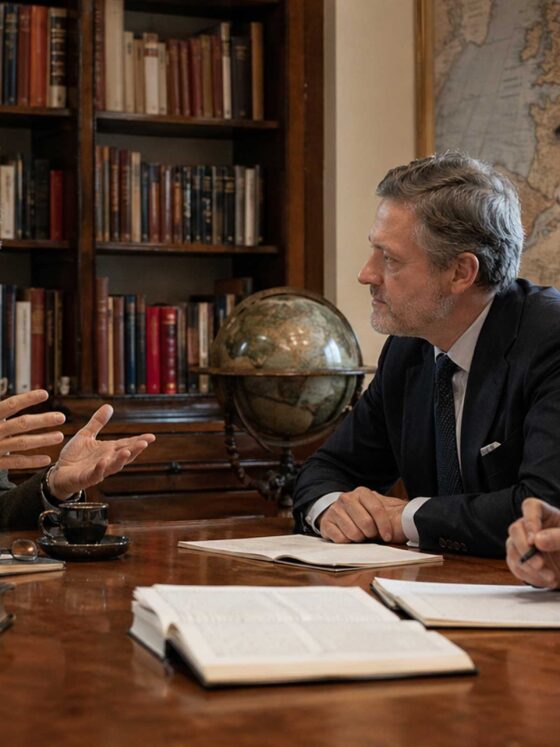
Yet, interim authorities’ task is not merely to look ahead; they must also look back and provide accountability for a past that is not theirs. The government is called to develop a clear map of accountability for past – and current – violations and violence. Syrians deserve to know who will be held responsible, when, and how. Only by confronting this history can Syrians hope to plant new roots in a soil that is no longer poisoned by impunity. As moderator of the event ‘Towards a Holistic Accountability Framework for Syria: Is It Possible?’ organised at the side of the 58th HRC, Mr. Tabbara expressed his thoughts on the current situation, looking at the promised engagement between the Syrian government and civil society. “It was encouraging to see the government of Syria engaged in a public event of this nature.
We hope and will continue to push for a robust role for Syrian civil society that has been focused on holding their government accountable.” To conclude. The future of the Syrian people is unwritten for the very first time and this brings a beam of light to the region. The goal is to have a unified yet heterogeneous state to reflect the concerns of its constituents, but to do so, interim authorities need to forget their rushing checklist of duties and instead take a slower yet steady path in this transitional justice, grounded in national and international collaboration.
Share
You Might Also Like