To me, the most beautiful word on the dictionary is “tariff
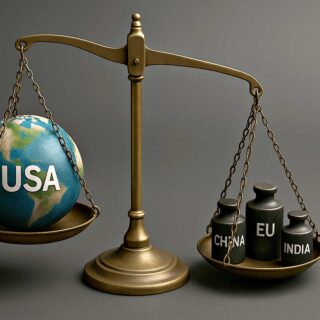
With these words, in November 2024, President Trump announced his agenda for 2025 and the four upcoming years. Now that he is back in the White House for his second mandate, the radar of speculations about his next moves is constantly on. We all know that Trump intends to impose tariffs as high as 60% towards China, and 20% against the EU, hitting – and sinking – the car manufacturing sector. If 2025 will be, as assumed, the year of ‘America First’ protectionism, then what to expect from the trade game?
Looking towards the East, China is redirecting its vision and efforts towards the emergent markets in the Global South, strengthening its role as a trade partner. China’s growth will be increasingly carried by its relationships with the Global South – a possible defence vis-à-vis la Washington’s tariffs? Most likely. If it is true that Biden never called off the first round of tariffs imposed by Trump, we are only more sure that Chinese exports towards the States will definitely decrease in the upcoming years. So, where to turn? As mentioned above, the Global South is already offering appetible alternatives for economic cooperation, as shown by the bilateral agreement between Xi Jinping (China) and Modi (India) at the BRICS meeting in Kazan (October, 22-24, 2024) to promote growth and stability at the regional level. But China looks towards the West as well, not scared of the long-lasting friendship between Bruxelles and Washington. President Xi Jinping told European Council President (Antonio Costa) that China is open to continuing and boosting their 50-year economic relationship, bringing more certainty to the turbulent international landscape – as long as they respect each other and engage in a transparent dialogue.2 Will this become a reality? What about Europe’s dream of becoming autonomous and competitive in the international market? Wasn’t it exactly in such moments of crisis that the European Union found its light, overcoming internal divisions? Costa has already put his hands forward, nodding to the idea of a strategic commercial relationship with China, noting that both uphold multilateralism, safeguard free trade and oppose bloc confrontation. In such a context of economic instability, the scenario of a global restructuring of commercial routes is not too far from reality, favouring the repositioning of supply chains, without necessarily harming global trade. According to a recent publication of Boston Consulting Group, it will keep growing at a yearly rate of 2,9% for the next 10 years.
In conclusion, what to expect? China is strengthening its regional relationships, anticipating the burden of US tariffs, and the EU is moving – apparently – in the same direction… Will the EU be able not to succumb to China and create a competitive economy worthy of its name? The clock is ticking, and the new barriers will pose severe challenges to the hopes of Mario Draghi, as reported in 2024.
Share